I was working on something this week that turned out to be so convoluted, fragmented and full of contradictory elements that I realized last night that there was no way that I could do the subject justice in time to post an article today. I haven’t given up on it – it is an interesting line of research – but I don’t want to do it or you (or me) the disservice of posting something that is less than what it should be.
Fortunately, I have a backup plan for just such an occasion, and it isn’t just filler. It’s something that everyone interested in UFOs should absolutely take a look at. Here it comes now!
The Man Who Invented Flying Saucers
by John Keel
In 1947, the editor of Amazing Stories watched in astonishment as the things he had been fabricating for years in his magazine suddenly came true!
North America’s “Bigfoot” was nothing more than an Indian legend until a zoologist named Ivan T. Sanderson began collecting contemporary sightings of the creature in the early 1950s, publishing the reports in a series of popular magazine articles. He turned the tall, hairy biped into a household word, just as British author Rupert T. Gould rediscovered sea serpents in the 1930s and, through his radio broadcasts, articles, and books, brought Loch Ness to the attention of the world. Another writer named Vincent Gaddis originated the Bermuda Triangle in his 1965 book, Invisible Horizons: Strange Mysteries of the Sea. Sanderson and Charles Berlitz later added to the Triangle lore, and rewriting their books became a cottage industry among hack writers in the United States.
 Charles Fort put bread on the table of generations of science fiction writers when, in his 1931 book Lo!, he assembled the many reports of objects and people strangely transposed in time and place, and coined the term “teleportation.” And it took a politician named Ignatius Donnelly to revive lost Atlantis and turn it into a popular subject (again and again and again).1
But the man responsible for the most well-known of all such modern myths – flying saucers – has somehow been forgotten. Before the first flying saucer was sighted in 1947, he suggested the idea to the American public. Then he converted UFO reports from what might have been a Silly Season phenomenon into a subject, and kept that subject alive during periods of total public disinterest. His name was Raymond A. Palmer.
Born in 1911, Ray Palmer suffered severe injuries that left him dwarfed in stature and partially crippled. He had a difficult childhood because of his infirmities and, like many isolated young men in those pre-television days, he sought escape in “dime novels,” cheap magazines printed on coarse paper and filled with lurid stories churned out by writers who were paid a penny a word. He became an avid science fiction fan, and during the Great Depression of the 1930s he was active in the world of fandom – a world of mimeographed fanzines and heavy correspondence. (Science fiction fandom still exists and is very well organized with well-attended annual conventions and lavishly printed fanzines, some of which are even issued weekly.) In 1930, he sold his first science fiction story, and in 1933 he created the Jules Verne Prize Club which gave out annual awards for the best achievements in sci-fi. A facile writer with a robust imagination, Palmer was able to earn many pennies during the dark days of the Depression, undoubtedly buoyed by his mischievous sense of humor, a fortunate development motivated by his unfortunate physical problems. Pain was his constant companion.
In 1938, the Ziff-Davis Publishing Company in Chicago purchased a dying magazine titled Amazing Stories. It had been created in 1929 by the inestimable Hugo Gernsback, who is generally acknowledged as the father of modern science fiction. Gernsback, an electrical engineer, ran a small publishing empire of magazines dealing with radio and technical subjects. (he also founded Sexology, a magazine of soft-core pornography disguised as science, which enjoyed great success in a somewhat conservative era.) It was his practice to sell – or even give away – a magazine when its circulation began to slip. Although Amazing Stories was one of the first of its kind, its readership was down to a mere 25,000 when Gernsback unloaded it on Ziff-Davis. William B. Ziff decided to hand the editorial reins to the young science fiction buff from Milwaukee, Wisconsin. At the age of 28, Palmer found his life’s work.
Expanding the pulp magazine to 200 pages (and as many as 250 pages in some issues), Palmer deliberately tailored it to the tastes of teenaged boys. He filled it with nonfiction features and filler items on science and pseudo-science in addition to the usual formula short stories of BEMs (Bug-Eyed Monsters) and beauteous maidens in distress. Many of the stories were written by Palmer himself under a variety of pseudonyms such as Festus Pragnell and Thorton Ayre, enabling him to supplement his meager salary by paying himself the usual penny-a-word. His old cronies from fandom also contributed stories to the magazine with a zeal that far surpassed their talents. In fact, of the dozen or so science fiction magazines then being sold on the newsstands, Amazing Stories easily ranks as the very worst of the lot. Its competitors, such as Startling Stories, Thrilling Wonder Stories, Planet Stories and the venerable Astounding (now renamed Analog) employed skilled, experienced professional writers like Ray Bradbury, Isaac Asimov, and L. Ron Hubbard (who later created Dianetics and founded Scientology). Amazing Stories was garbage in comparison and hardcore sci-fi fans tended to sneer at it.2
The magazine might have limped through the 1940s, largely ignored by everyone, if not for a single incident. Howard Browne, a television writer who served as Palmer’s associate editor in those days, recalls: “early in the 1940s, a letter came to us from Dick Shaver purporting to reveal the “truth” about a race of freaks, called “Deros,” living under the surface of the earth. Ray Palmer read it, handed it to me for comment. I read a third of it, tossed it in the waste basket. Ray, who loved to show his editors a trick or two about the business, fished it out of the basket, ran it in Amazing, and a flood of mail poured in from readers who insisted every word of it was true because they’d been plagued by Deros for years.”3
Actually, Palmer had accidentally tapped a huge, previously unrecognized audience. Nearly every community has at least one person who complains constantly to the local police that someone – usually a neighbor – is aiming a terrible ray gun at their house or apartment. This ray, they claim, is ruining their health, causing their plants to die, turning their bread moldy, making their hair and teeth fall out, and broadcasting voices into their heads. Psychiatrists are very familiar with these “ray” victims and relate the problem with paranoid-schizophrenia. For the most part, these paranoiacs are harmless and usually elderly. Occasionally, however, the voices they hear urge them to perform destructive acts, particularly arson. They are a distrustful lot, loners by nature, and very suspicious of everyone, including the government and all figures of authority. In earlier times, they thought they were hearing the voice of God and/or the Devil. Today they often blame the CIA or space beings for their woes. They naturally gravitate to eccentric causes and organizations which reflect their own fears and insecurities, advocating bizarre political philosophies and reinforcing their peculiar belief systems. Ray Palmer unintentionally gave thousands of these people focus to their lives.
Shaver’s long, rambling letter claimed that while he was welding4 he heard voices which explained to him how the underground Deros were controlling life on the surface of the earth through the use of fiendish rays. Palmer rewrote the letter, making a novelette out of it, and it was published in the March 1945 issue under the title: “I Remember Lemuria Š” by Richard Shaver.
The Shaver Mystery was born.
Somehow the news of Shaver’s discovery quickly spread beyond science fiction circles and people who had never before bought a pulp magazine were rushing to their local newsstands. The demand for Amazing Stories far exceeded the supply and Ziff-Davis had to divert paper supplies (remember there were still wartime shortages) from other magazines so they could increase the press run of AS.
“Palmer traveled to Pennsylvania to talk to Shaver,” Howard Brown later recalled, “found him sitting on reams of stuff he’d written about the Deros, bought every bit of it and contracted for more. I thought it was the sickest crap I’d run into. Palmer ran it and doubled the circulation of Amazing within four months.”
 By the end of 1945, Amazing Stories was selling 250,000 copies per month, an amazing circulation for a science fiction pulp magazine. Palmer sat up late at night, rewriting Shaver’s material and writing other short stories about the Deros under pseudonyms. Thousands of letters poured into the office. Many of them offered supporting “evidence” for the Shaver stories, describing strange objects they had seen in the sky and strange encounters they had had with alien beings. It seemed that many thousands of people were aware of the existence of some distinctly nonterrestrial group in our midst. Paranoid fantasies were mixed with tales that had the uncomfortable ring of truth. The “Letters-to-the-Editor” section was the most interesting part of the publication. Here is a typical contribution from the issue for June 1946:
Sirs:
I flew my last combat mission on May 26 [1945] when I was shot up over Bassein and ditched my ship in Ramaree roads off Chedubs Island. I was missing five days. I requested leave at Kashmere (sic). I and Capt. (deleted by request) left Srinagar and went to Rudok then through the Khese pass to the northern foothills of the Karakoram. We found what we were looking for. We knew what we were searching for.
For heaven’s sake, drop the whole thing! You are playing with dynamite. My companion and I fought our way out of a cave with submachine guns. I have two 9″ scars on my left arm that came from wounds given me in the cave when I was 50 feet from a moving object of any kind and in perfect silence. The muscles were nearly ripped out. How? I don’t know. My friend has a hole the size of a dime in his right bicep. It was seared inside. How we don’t know. But we both believe we know more about the Shaver Mystery than any other pair.
You can imagine my fright when I picked up my first copy of Amazing Stories and see you splashing words about the subject.
The identity of the author of this letter was withheld by request. Later Palmer revealed his name: Fred Lee Crisman. He had inadvertently described the effects of a laser beam – even though the laser wasn’t invented until years later. Apparently Crisman was obsessed with Deros and death rays long before Kenneth Arnold sighted the “first” UFO in June 1947.
In September 1946, Amazing Stories published a short article by W.C. Hefferlin, “Circle-Winged Plane,” describing experiments with a circular craft in 1927 in San Francisco. Shaver’s (Palmer’s) contribution to that issue was a 30,000 word novelette, Earth Slaves to Space, dealing with spaceships that regularly visited the Earth to kidnap humans and haul them away to some other planet. Other stories described amnesia, an important element in the UFO reports that still lay far in the future, and mysterious men who supposedly served as agents for those unfriendly Deros.
A letter from army lieutenant Ellis L. Lyon in the September 1946 issue expressed concern over the psychological impact of the Shaver Mystery.
What I am worried about is that there are a few, and perhaps quite large number of readers who may accept this Shaver Mystery as being founded on fact, even as Orson Welles put across his invasion from Mars, via radio some years ago. It is of course, impossible for the reader to sift out in your “Discussions” and “Reader Comment” features, which are actually letters from readers and which are credited to an Amazing Stories staff writer, whipped up to keep alive interest in your fictional theories. However, if the letters are generally the work of readers, it is distressing to see the reaction you have caused in their muddled brains. I refer to the letters from people who have “seen” the exhaust trails of rocket ships or “felt” the influence of radiations from underground sources.
Palmer assigned artists to make sketches of objects described by readers and disc-shaped flying machines appeared on the covers of his magazine long before June 1947. So we can note that a considerable number of people – millions – were exposed to the flying saucer concept before the national news media was even aware of it. Anyone who glanced at the magazines on a newsstand and caught a glimpse of the saucers-adorned Amazing Stories cover had the image implanted in his subconscious. In the course of the two years between march 1945 and June 1947, millions of Americans had seen at least one issue of Amazing Stories and were aware of the Shaver Mystery with all of its bewildering implications. Many of these people were out studying the empty skies in the hopes that they, like other Amazing Stories readers, might glimpse something wondrous. World War II was over and some new excitement was needed. Raymond Palmer was supplying it – much to the alarm of Lt. Lyon and Fred Crisman.
Aside from Palmer’s readers, two other groups were ready to serve as cadre for the believers. About 1,500 members of Tiffany Thayer’s Fortean Society knew that weird aerial objects had been sighted throughout history and some of them were convinced that this planet was under surveillance by beings from another world. Tiffany Thayer was rigidly opposed to Franklin Roosevelt and loudly proclaimed that almost everything was a government conspiracy, so his Forteans were fully prepared to find new conspiracies hidden in the forthcoming UFO mystery. They would become instant experts, willing to educate the press and public when the time came. The second group were spiritualists and students of the occult, headed by Dr. Meade Layne, who had been chatting with the space people at seances through trance mediums and Ouija boards. They knew the space ships were coming and hardly surprised when “ghost rockets” were reported over Europe in 1946.5 Combined, these three groups represented a formidable segment of the population.
On June 24, 1947, Kenneth Arnold made his famous sighting of a group of “flying saucers” over Mt. Rainier, and in Chicago Ray Palmer watched in astonishment as the newspaper clippings poured in from every state. The things that he had been fabricating for his magazine were suddenly coming true!
For two weeks, the newspapers were filled with UFO reports. Then they tapered off and the Forteans howled “Censorship!” and “Conspiracy!” But dozens of magazine writers were busy compiling articles on this new subject and their pieces would appear steadily during the next year. One man, who had earned his living writing stories for the pulp magazines in the 1930s, saw the situation as a chance to break into the “slicks” (better quality magazines printed on glossy or “slick” paper). Although he was 44 years old at the time of Pearl Harbor, he served as a Captain in the marines until he was in a plane accident. Discharged as a Major (it was the practice to promote officers one grade when they retired), he was trying to resume his writing career when Ralph Daigh, an editor at True magazine, assigned him to investigate the flying saucer enigma. Thus, at the age of 50, Donald E. Keyhhoe entered Never-Never-Land. His article, “Flying Saucers Are Real,” would cause a sensation, and Keyhoe would become an instant UFO personality.
 That same year, Palmer decided to put out an all-flying saucer issue of Amazing Stories. Instead, the publisher demanded that he drop the whole subject after, according to Palmer, two men in Air Force uniforms visited him. Palmer decided to publish a magazine of his own. Enlisting the aid of Curtis Fuller, editor of a flying magazine, and a few other friends, he put out the first issue of Fate in the spring of 1948. A digest-sized magazine printed on the cheapest paper, Fate was as poorly edited as Amazing Stories and had no impact on the reading public. But it was the only newsstand periodical that carried UFO reports in every issue. The Amazing Stories readership supported the early issues wholeheartedly.
In the fall of 1948, the first flying saucer convention was held at the Labor Temple on 14th Street in New York City. Attended by about thirty people, most of whom were clutching the latest issue of Fate, the meeting quickly dissolved into a shouting match.6 Although the flying saucer mystery was only a year old, the side issues of government conspiracy and censorship already dominated the situation because of their strong emotional appeal. The U.S. Air Force had been sullenly silent throughout 1948 while, unbeknownst to the UFO advocates, the boys at Wright-Patterson Air Force Base in Ohio were making a sincere effort to untangle the mystery.
When the Air Force investigation failed to turn up any tangible evidence (even though the investigators accepted the extraterrestrial theory) General Hoyt Vandenburg, Chief of the Air Force and former head of the CIA, ordered a negative report to release to the public. The result was Project Grudge, hundreds of pages of irrelevant nonsense that was unveiled around the time True magazine printed Keyhoe’s pro-UFO article. Keyhoe took this personally, even though his article was largely a rehash of Fort’s book, and Ralph Daigh had decided to go with the extraterrestrial hypothesis because it seemed to be the most commercially acceptable theory (that is, it would sell magazines).
Palmer’s relationship with Ziff-Davis was strained now that he was publishing his own magazine. “when I took over from Palmer, in 1949,” Howard Browne said, “I put an abrupt end to the Shaver Mystery – writing off over 7,000 dollars worth of scripts.”
Moving to Amherst, Wisconsin, Palmer set up his own printing plant and eventually he printed many of those Shaver stories in his Hidden Worlds series. As it turned out, postwar inflation and the advent of television was killing the pulp magazine market anyway. In the fall of 1949, hundreds of pulps suddenly ceased publication, putting thousands of writers and editors out of work. Amazing Stories has often changed hands since but is still being published, and is still paying its writers a penny a word.7
For some reason known only to himself, Palmer chose not to use his name in Fate. Instead, a fictitious “Robert N. Webster” was listed as editor for many years. Palmer established another magazine, Search, to compete with Fate. Search became a catch-all for inane letters and occult articles that failed to meet Fate‘s low standards.
Although there was a brief revival of public and press interest in flying saucers following the great wave of the summer of 1952, the subject largely remained in the hands of cultists, cranks, teenagers, and housewives who reproduced newspaper clippings in little mimeographed journals and looked up to Palmer as their fearless leader.
In June, 1956, a major four-day symposium on UFOs was held in Washington, D.C. It was unquestionably the most important UFO affair of the 1950s and was attended by leading military men, government officials and industrialists. Men like William Lear, inventor of the Lear Jet, and assorted generals, admirals and former CIA heads freely discussed the UFO “problem” with the press. Notably absent were Ray Palmer and Donal Keyhoe. One of the results of the meetings was the founding of the National Investigation Committee on Aerial Phenomena (NICAP) by a physicist named Townsend Brown. Although the symposium received extensive press coverage at the time, it was subsequently censored out of UFO history by the UFO cultists themselves – primarily because they had not participated in it.8
The American public was aware of only two flying saucer personalities, contactee George Adamski, a lovable rogue with a talent for obtaining publicity, and Donald Keyhoe, a zealot who howled “Coverup!” and was locked in mortal combat with Adamski for newspaper coverage. Since Adamski was the more colorful (he had ridden a saucer to the moon), he was usually awarded more attention. The press gave him the title of “astronomer” (he lived in a house on Mount Palomar where a great telescope was in operation), while Keyhoe attacked him as “the operator of a hamburger stand.” Ray Palmer tried to remain aloof of the warring factions, so naturally, some of them turned against him.
The year 1957 was marked by several significant developments. There was another major flying saucer wave. Townsend Brown’s NICAP floundered and Keyhoe took it over. And Ray Palmer launched a new newsstand publication called Flying Saucers From Other Worlds. In the early issues he hinted that they knew some important “secret.” After tantalizing his readers for months, he finally revealed that UFOs came from the center of the earth and the phrase “From Other Worlds” was dropped from the title. His readers were variously enthralled, appalled, and galled by the revelation.
For seven years, from 1957 to 1964, ufology in the United States was in total limbo. This was the Dark Age. Keyhoe and NICAP were buried in Washington, vainly tilting at windmills and trying to initiate a congressional investigation into the UFO situation.
 A few hundred UFO believers clustered around Coral Lorenzen’s Aerial Phenomena Research Organization (APRO). And about 2,000 teenagers bought Flying Saucers from newsstands each month. Palmer devoted much space to UFO clubs, information exchanges, and letters-to-the-editor. So it was Palmer, and Palmer alone, who kept the subject alive during the Dark Age and lured new youngsters into ufology. He published his strange books about Deros, and ran a mail-order business selling the UFO books that had been published after various waves of the 1950s. His partners in the Fate venture bought him out, so he was able to devote his full time to his UFO enterprises.
Palmer had set up a system similar to sci-fi fandom, but with himself as the nucleus. He had come a long way since his early days and the Jules Verne Prize Club. He had been instrumental in inventing a whole system of belief, a frame of reference – the magical world of Shaverism and flying saucers – and he had set himself up s the king of that world. Once the belief system had been set up it became self-perpetuating. The people beleaguered by mysterious rays were joined by the wishful thinkers who hoped that living, compassionate beings existed out there beyond the stars. They didn’t need any real evidence. The belief itself was enough to sustain them.
When a massive new UFO wave – the biggest one in U.S. history – struck in 1964 and continued unabated until 1968, APRO and NICAP were caught unawares and unprepared to deal with renewed public interest. Palmer increased the press run of Flying Saucers and reached out to a new audience. Then in the 1970s, a new Dark Age began. October 1973 produced a flurry of well-publicized reports and then the doldrums set in. NICAP strangled in its own confusion and dissolved in a puddle of apathy, along with scores of lesser UFO organizations. Donald Keyhoe, a very elder statesman, lives in seclusion in Virginia. Most of the hopeful contactees and UFO investigators of the 1940s and 50s have passed away. Palmer’s Flying Saucers quietly self-destructed in 1975, but he continued with Search until his death in 1977. Richard Shaver is gone but the Shaver Mystery still has a few adherents. Yet the sad truth is that none of this might have come about if Howard Browne hadn’t scoffed at that letter in that dingy editorial office in that faraway city so long ago.
________________________________________________________________________________
Footnotes
- Donnelly’s book, Atlantis, published in 1882, set off a 50-year wave of Atlantean hysteria around the world. Even the characters who materialized at seances during that period claimed to be Atlanteans.
- The author was an active sci-fi fan in the 1940s and published a fanzine called Lunarite. Here’s a quote from Lunarite dated October 26, 1946: “Amazing Stories is still trying to convince everyone that the BEMs in the caves run the world. And I was blaming it on the Democrats. ‘Great Gods and Little Termites’ was the best tale in this ish [issue]. But Shaver, author of the ‘Land of Kui,’ ought to give up writing. He’s lousy. And the editors of AS ought to joint Sgt. Saturn on the wagon and quit drinking that Xeno or the BEMs in the caves will get them.” I clearly remember the controversy created by the Shaver Mystery and the great disdain with which the hardcore fans viewed it.
- From Cheap Thrills: An Informal History of the Pulp Magazines by Ron Goulart (published by Arlington House, New York, 1972).
- It is interesting that so many victims of this type of phenomenon were welding or operating electrical equipment such as radios, radar, etc. when they began to hear voices.
- The widespread “ghost rockets” of 1946 received little notice in the U.S. press. I remember carrying a tiny clipping around in my wallet describing mysterious rockets weaving through the mountains of Switzerland. But that was the only “ghost rocket” report that reached me that year.
- I attended this meeting but my memory of it is vague after so many years. I cannot recall who sponsored it.
- A few of the surviving science fiction magazines now pay (gasp!) three cents a word. But writing sci-fi still remains a sure way to starve to death.
- When David Michael Jacobs wrote The UFO Controversy in America, a book generally regarded as the most complete history of the UFO maze, he chose to completely revise the history of the 1940s and 50s, carefully excising any mention of Palmer, the 1956 symposium, and many of the other important developments during that period.



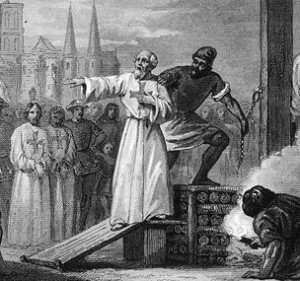 And speaking of good fake stories, another one that involves De Molay and may or may not have also been in The Da Vinci Code (I honestly can’t remember) is the one that says that just before he was burned at the stake, he told Phil-4 and Pope Clement that they would be called to judgment for their crimes within a year. Both of them did die less than a year after this: Phil after suffering a stroke while hunting and Clement after a long illness. By some accounts, he died screaming that he was burning up. However, most believe that this curse was invented after their deaths in order to further mythologize the status of De Molay and the Knights Templar.