“In this book it is spoken of the Sephiroth and the Paths; of Spirits and Conjurations; of Gods, Spheres, Planes, and many other things which may or may not exist. It is immaterial whether these exist or not. By doing certain things certain results will follow; students are most earnestly warned against attributing objective reality or philosophic validity to any of them”—Aleister Crowley, Magick in Theory and Practice
In 1918, the famous (or infamous) occultist Aleister Crowley was living in New York and had shacked up with a married woman named Roddie Minor, whom he used as a medium in some of his esoteric experiments. Minor – who Crowley refers to as “the Camel” in his writings on the subject, a sobriquet that I can’t believe any woman would take as a compliment – seemed to have a knack for accessing the astral plane. Using both hash and opium for visualization facilitation, she would enter a trance state where she had a number of encounters with some rather interesting inhabitants of that realm, including a wizard who called himself Amalantrah. Much of the content in Minor’s visions centered around the symbol of the egg, along with Amalantrah’s exhortations “It’s all in the egg,” and, concerning the egg, “Thou art to go this way.”
To many, all of this can easily be dismissed as drug induced hallucination, and it’s difficult to argue otherwise. However, Crowley was by no means the first or last person to assert that hallucinogenic substances can actually open the mind to non-ordinary states of consciousness where it is possible access other levels of reality. Shamanic traditions from all over the globe would back him up on this. So would some scientists who have done research in this area.
 At this point in the story, things get a little hazy. We know that Crowley soon headed back to Europe. We also know that using techniques obtained during sessions with Roddie Minor that came to be called “the Amalantrah Working,” Crowley was able to achieve contact with a being called Lam. It is unclear whether this was a purely psychic connection or if Lam actually materialized. We don’t even know if this being said that its name was Lam or if that’s just what Crowley decided to call him. “Lam” is the Tibetan word for “path,” while “lama” is “one who is on the path.” Further still, we don’t even know what they talked about. What we do know is that at some point Crowley drew a sketch of Lam, and its resemblance to what we now refer to as the gray aliens has gotten some attention of late.
A first glance might make you think that the head is about right, but where are the big black eyes? A closer inspection reveals that, while Lam does have beady little eyes, the contours of his skull are suggestive of the size and shape of the eyes of the standard description of the grays. Okay, so dents in the forehead aren’t eyes. Fair enough. That hasn’t stopped people from multiple camps, including the Typhonians (see below), from concluding that Crowley was the first to connect with these beings and may be responsible for their presence here now. Superimposing Lam’s picture over the cover illustration of Whitley Stieber’s Communion does 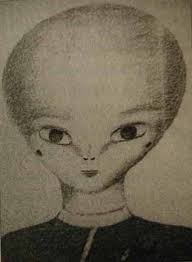 show a marked resemblance, eyes notwithstanding. Another point that I find to be of interest is that Strieber has said that the only major flaw in the artist’s rendering of the creature that he encountered is that her eyes were actually much larger, which Crowley’s sketch clearly indicates would be the case if Lam’s cranial indentations were replaced with eyes. The beings described by some abduction experiencers back in the 1960s and 70s seem like a hybrid between Lam and the more current description of the grays. Their abductors had the same large heads and eyes, but the eyes were more like ours with irises and pupils, which is also the case with Lam.
Crowley was a member, and later the Outer Head (their term for CEO), of an occult order known as the Ordo Templi Orientis (OTO). The OTO is widely regarded as the “bad boy” of occult orders, even by some other occultists. However, the accusations that they are Satanists are unfounded as far as I’m concerned. These are usually leveled by conservative Christians who are appalled by some of the Order’s practices which they find morally scandalous. Crowley absolutely loved this. Outraging Christians was one of his favorite pastimes, and he was really good at it. If it was an Olympic event, he would’ve won the gold. I point all of this out because there is no shortage of people who have branded Crowley as a Satanist and Lam as a demon, which is untrue in the case of the former and only one possibility in the latter. Okay, so he did call himself the Great Beast and used 666 as his magical number, but the reasons for that are more complicated than what it seems on the surface. Crowley may have been an amoral narcissist, and he was certainly no Christian, but he was also no Satanist.
Anyway, Crowley never mentions Lam in his magical diary of the time. He mentions Amalantrah and the symbolism of the egg a number of times, but nothing about Lam. It’s possible that Crowley decided to forget about him and instead focus his energies on spreading the message of The Book of the Law, which is widely considered to be his greatest occult contribution. But Crowley was reportedly not immediately impressed with this book. According to Israel Regardie, it was not until many years later that he came to embrace most of it, though there were still parts that he reportedly considered distasteful ’til the day he died. So why keep quiet about so significant an event as contact with an otherworldly being? This makes even less sense when you consider that this magical diary was later published as The Magical Record of the Beast 666 in 1972. It was edited by John Symonds and Kenneth Grant, and in an afterword they state that Crowley was so unguarded in these writings because he never thought that anyone else would read them. It seems almost impossible to believe that he would have excluded Lam even from his own personal notes.
Then again, maybe he didn’t. One of these two editors, Kenneth Grant, was given the drawing of Lam by Crowley in 1945. There’s no record that I’m aware of concerning what they may have discussed at the time, but Grant went on to form the New Isis Lodge within the OTO not long after Crowley’s death. The manifesto for this lodge so annoyed Karl Germer, Crowley’s successor as Outer Head of the OTO, that he kicked Grant out. Grant responded by announcing that he was the new Outer Head, which caused a split within the order, which happens with some regularity in these types of organizations. When Germer died in 1962, it would seem that Grant’s position as Outer Head was solidified. He then went on to found the Typhonian Order, which while still dedicated to previous OTO doctrine, was focused primarily on establishing contact with “praeter-humans” like Lam. Grant clearly considered this to be of the utmost importance, and this is most likely what got on Germer’s nerves to begin with. It’s possible that Crowley did write about his contact with Lam, but Grant decided to edit it out as being too sacred to be so publicly displayed before the profane masses in a book. This isn’t that farfetched a notion. Occult fraternities are very secretive about most of their doctrines and practices. They are, after all, secret societies.
 But we do have a fairly detailed set of instructions on how to connect with Lam. It came not from Crowley in the early 1900s, but from Kenneth Grant in a 1987 communique entitled “The Dikpala (stop snickering) of the Way of Silence: The Lam Statement.” I’m not going to go over the process for making contact here, partly because it’s easy enough to find on your own if you so desire, but mostly because I don’t want to be even partly responsible for any negative consequences of people playing around with things that they don’t understand. Grant warned that this is a dangerous procedure and cautions that the operation should only be attempted by IX° initiates of the OTO, which I‘m assuming that most of you are not. Your guess is as good as mine as to why they later chose to post this text on their website.
It seems likely that Crowley must have told Grant something that he found compelling when he received the Lam sketch. It would be hard to fathom a reason why Grant became so fascinated with Lam otherwise. Also, the methods Grant made known for contacting Lam were in practice decades before he released them to the general OTO public. It’s unlikely that he just pulled them out of thin air in the 1960s. It seems logical to conclude that both he and Crowley knew more than either of them were letting on.
What is clear from this document is that Grant is certain that the egg which was featured so prominently in the Amalantrah visions is Lam’s head. Going into the egg means literally getting into the mind of Lam and looking out through his eyes* upon “an alien world.” 1987 just happens to be the same year that Whitley Strieber’s Communion came out, a book that many consider to be about extraterrestrials, though Strieber himself is less convinced. Grant shares this lack of certainty as to the extraterrestrial origin of Lam. In “The Lam Statement,” he writes
Whether these visitors are regarded as visitors from outer space, or as welling up from the depths of some inner space, is neither here nor there. The dichotomy of ‘inner and outer’ is purely conceptual, arising from the dualist notion of an individual being somehow separate from the rest of the universe, which is somehow ‘out there.’ There is in fact nothing outside consciousness, which is a continuum.
This should be a familiar theme by now to those of you who are regular visitors to this site. It’s also made clear in this document that by the term “Lam,” Grant does not necessarily mean a specific, singular entity but rather all entities of this nature.
Perhaps not so coincidentally, ”visitors” is the same term Strieber uses for the beings he writes about in Communion. Since I have no exact date for the release of “The Lam Statement,” it’s possible that Grant read Communion before he wrote it. Maybe the success of Communion is what prompted him to write it in the first place. Whether it’s a coincidence or not, it is clear that many consider Lam and his ilk to be the same intelligence encountered by Strieber and other UFO contactees.
 More importantly, Michael Bertiaux, a member of the OTO, claimed to have had great success in contacting Lam using the techniques not mentioned above in the 1960s. He is reported to have said that he considers contact with Lam to be the next step in our evolution of spiritual growth. Strieber has said repeatedly that he believes that the “visitors” may be a force of evolution and that whatever it is that they’re doing with us is all about the soul.
Another notable similarity between the UFO experience and seeking contact with Lam is in Grant’s warning that this operation may lead to a feeling of disconnectedness from reality or a sense of the unreality of the objective universe. The sensation of being in some sort of trance or dream state is not uncommon in those who report having had a UFO related experience, and it doesn’t have to be a full-blown “alien contact” scenario, although it is almost universal in these instances. Sometimes people who merely report seeing a UFO say that they felt as if they were in some kind of altered state of consciousness.
Finally, although I’m not at all sure what to make of this, I would be remiss if I didn’t point out that Grant claimed that Lam was a gateway to the Void. The numerological value of “Lam” as calculated by Crowley is 71, the meaning of which is “No Thing.” In 1959, two Naval Intelligence officers allegedly made telepathic contact with a being that claimed to be from Uranus. This being said that its name was Affa. In the Enochian language communicated to Dr. John Dee by “angels” in the 16th century, “Affa” means “nothing” or “the void.” Bizarre coincidences do tend to pile up in Chapel Perilous.
I’d love to tell you more, but that’s all I know. Maybe Amalantrah and Lam were both just drug induced hallucinations and Crowley got lucky with the similarity between his sketch and the grays. Maybe Lam was just an image that Crowley somehow pulled out of the collective unconscious and that’s why he had nothing substantive to say on the subject. Make of it what you will.
For those of you who would like to know more about Crowley, I refer you to Israel Regardie’s biography The Eye in the Triangle. I’ve been told that there are other good biographies of Crowley as well, most notably John Symond’s The Great Beast, but I haven’t read them. The only person I’ve ever read more than one biography of was Jesus, and that’s because all four of those are pretty short.
Tune in next week when we’ll take a look at a supposedly related series of events, although I’ll be damned if I can find the connection. Maybe it will come to me as I delve a little deeper into them.
____________________________________________________________________________________
*Could the larger eyes seen today be somehow symbolic of this? Maybe having others look through your eyes makes them larger. I’m being somewhat facetious here, but you never know. The grays have shown themselves to be big fans of communicating symbolically. Or maybe I’m looking for connections where none exist.




 After her death in 2001, it was purchased at an estate sale in Portland, Oregon by a man named Kevin Mannis, who later sold it on eBay. The listing included the rather lengthy story of the box and what had happened to him and those close to him after he bought it
 The box itself was made of mahogany and built with no handles on the double doors that open in front. They both swing open simultaneously when the small drawer at the bottom is pulled out so that light fills the entire interior uniformly, indicating that its builder intended it to be a vessel dedicated to God. There was also a common Jewish prayer inscribed on the back that translates as “Hear O Israel, the Lord is our God, the Lord is one. Blessed is the name of his honored kingdom forever.”
 As soon as he brought it home, he started having a recurring nightmare. He would be walking with a friend when he would realize that the “friend” was really something evil. The person would then transform into a demonic hag and attack him. He claims that he would sometimes wake up with marks and bruises where the hag had hit him. He still saw no connection to the box.
 Jason Haxton, the next and current owner of the box, was the Director of the A.T. Still University Museum of Osteopathic Medicine in Kirksville where he learned about the box from one of the owner’s roommates. When Haxton offered to buy the box outright, the owner told him that if he wanted it, then he could bid on it like everyone else. (Does this guy strike anyone else as being a complete jackhole?) So that’s what he did. He got it for $280. He intended to give it to an illusionist friend of his to use in his act, but when he heard about its past, the man didn’t want it. This is unusual in itself considering how disdainful – and sometimes openly hostile – most stage magicians are toward anything paranormal, going all the way back to Harry Houdini, who spent more time exposing fraudulent mediums than escaping from straightjackets.
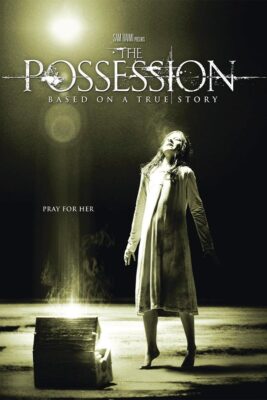 people who made the movie that was very loosely based on the actual events. Since the producers of The Possessed billed it as being “based on a true story” and then went on to present us with a movie that was a complete work of fiction, it was nice of them to include a short documentary about the real story of the Dybbuk Box as a bonus feature on the DVD as told by three of the people actually involved. That’s where you can see the actual Dybbuk Box, or at least the front of it since Haxton wouldn’t remove it from its ark or open it. In case you’re suggestible,